
Frequently
Asked Questions
How our fixed maintenance plans work, and straight answers on air conditioning, plumbing and electrical systems in Bali's tropical climate.

Start Here — Our Plans In Four Lines
Most questions we receive are about what a maintenance subscription covers and what sits outside it. This is the short version. The full detail is in the Plans & Subscriptions section below.
Fixed scope, transparent pricing, no surprise invoices. You always see the cost before we start.
Browse By Topic
Jump straight to a section, or use the search box below to find an answer across all 60 questions.
Plans & Subscriptions
How our fixed maintenance packages work
01Are Bali Pro Services maintenance plans customisable?
No. Our maintenance plans are fixed packages with defined service inclusions, visit frequency and terms.
You choose the plan that best suits your property, but the plans themselves are not customised or individually modified.
If you require work outside your selected plan, we can provide it as an additional scope of works, subject to assessment, quotation, approval, scheduling and additional charges.
02Can I add extra services to my maintenance plan?
Extra services are not added directly into the fixed maintenance plan. If additional work is required, we provide a separate scope of works, estimate or quotation for your approval.
Examples of additional work include:
- Major plumbing repairs
- Electrical repairs requiring specialists
- Air-conditioning servicing or repairs
- Pool repairs
- Roof repairs
- Painting
- Carpentry
- Renovation work
- Appliance replacement
- Pest control
- Deep cleaning
- Garden or landscaping work
- Any work requiring materials, parts, specialist tools or external contractors
Once approved, the additional work is scheduled separately or carried out during the visit where possible.
03What does "additional scope of works" mean?
An additional scope of works means work that falls outside the standard inclusions of your selected maintenance plan.
This may include larger repairs, specialist services, replacement parts, extended labour, or any task that cannot be completed as a minor on-the-spot repair during a scheduled maintenance visit.
We will usually provide details of the recommended work, the estimated cost, the materials required and a timeline before proceeding.
04Are additional works included in the monthly maintenance fee?
No. Additional works are not included in the monthly maintenance subscription fee. The monthly fee covers the services included in your selected fixed plan only.
Any extra work, materials, parts, consumables, specialist labour, contractor fees, procurement, delivery or extended service time is charged separately after your approval.
05Will you carry out extra work without approval?
No. We do not carry out additional chargeable work without your approval, except in urgent cases where immediate action is required to prevent property damage, safety risks or further loss.
Approval can be given through any approved communication channel: email, WhatsApp, the customer portal, a message, or another method confirmed with our office.
06Can I request services outside my maintenance plan?
Yes. You may request services outside your fixed maintenance plan. We review the request and confirm whether the work can be provided as an additional scope of works.
If available, the work is quoted separately and is subject to:
- Technician or contractor availability
- Site assessment
- Required materials or parts
- Your approval
- Scheduling
- Additional charges
07If my property needs more support, can I upgrade my plan?
If a higher fixed maintenance plan is offered, you may request to move to that plan, subject to availability, eligibility, pricing, billing terms and approval by our office.
Plan upgrades do not create a customised plan. They simply move you from one fixed package to another available package.
08Can I remove services from a plan to reduce the price?
No. Our maintenance plans are fixed packages. Services cannot be removed, exchanged or reduced in order to lower the monthly subscription fee.
We recommend selecting the fixed plan that best matches your property's needs.
09Can unused services be exchanged for other work?
No. Unused services, missed items or unused time within a fixed maintenance plan cannot be exchanged, transferred, credited, refunded or substituted for other work unless we agree in writing.
Additional work outside your selected plan is quoted and charged separately.
10What happens if an issue is found during a visit that is outside my plan?
If our technician identifies an issue that falls outside your selected plan, we may include it in the maintenance report with recommendations, photos where appropriate, an urgency level and estimated costs where available.
You can then decide whether to approve the additional scope of works.
11Are specialist services included in the maintenance plans?
Specialist services are not included in the standard maintenance plans unless expressly stated in your selected package.
Specialist services may include:
- Licensed electrical work
- Structural work
- Engineering assessments
- Air-conditioning servicing or repairs
- Pool repairs
- Pest control
- Roof repairs
- Appliance repairs
- Waterproofing
- Renovation or construction work
These services may be available separately as additional works.
12Can you coordinate contractors for extra work?
Yes. Where required, we may recommend, arrange or coordinate third-party contractors for additional specialist work.
Third-party work is separate from your fixed maintenance plan and may be subject to separate pricing, availability, warranties, timelines and approval.
13How do I request extra work outside my plan?
Send the request to our office through WhatsApp, email or the customer portal, with photos where possible. Extra work can be provided as additional works, subject to assessment, availability, quotation, approval and additional charges.
We come back to you with the recommended scope and the cost before anything is scheduled.
Inside The Plan vs. Quoted Separately
The simplest way to read your subscription: routine, predictable, scheduled work is inside the fee. Anything needing parts, specialists or extended labour is quoted first.
| Covered by the monthly fee | Quoted as an additional scope of works |
|---|---|
| 🔁 Scheduled visits | Extra visits requested outside the plan's frequency |
| 🔍 Property inspection | Engineering assessments · structural surveys |
| 🔩 Minor on-the-spot repairs | Major repairs · replacement parts · extended labour |
| ❄️ Plan-listed A/C care | Compressor work · gas top-up · relocation · new installs |
| 🚰 Basic plumbing checks | Pipe replacement · pump work · water-heater replacement |
| 📄 Maintenance report | Specialist contractor coordination · procurement · delivery |
| 💬 Office support | Pest control · deep cleaning · painting · landscaping · renovations |
Air Conditioning
Servicing, repairs and buying advice for Bali's climate
01When should I replace my air conditioner?
Life expectancy varies with climate, and Bali is hard on air conditioners. Constant humidity, salt-laden air near the coast and heavy year-round running hours mean most units here reach the end of their useful life at around 8 to 12 years, rather than the 13 to 15 years quoted in temperate countries.
The practical trigger is usually cost: once a unit needs a major repair, such as a compressor or a leaking coil, replacement is often the better investment. Falling cooling performance, rising electricity bills and repeated call-outs all point the same way.
02Why is my AC leaking water?
The main job of an air conditioner is to remove moisture from the air and drain it away. In Bali it removes a great deal of it, so drainage problems are the most common cause of leaks.
Usually the drain line is blocked by dust, dirt or algae, particularly where filters are not cleaned often. The second cause is more serious: ice. When refrigerant is low or airflow is restricted, the indoor coil freezes, water collects, turns to ice, pushes past the drain tray and then defrosts inside your ceiling or wall.
That water can soak plaster, feed mould and reach electronics. Switch the unit off, inspect with a torch, and call a technician before the damage spreads.
03Is it necessary to service my AC every year?
Once a year is the standard in a cool climate. In Bali it is not enough. Humidity, dust, construction work and salt air load up filters and coils far faster, so we recommend servicing every three months for units in regular use.
Regular servicing keeps the system clean, efficient and safe, and it catches small faults before they become a failure during the hottest week of the year.
04How often should AC coils be cleaned?
Coils should be cleaned at every service — quarterly for most Bali properties, and more often for villas near the beach or beside a building site.
During a clean, the technician checks the coil for fouling and leaks, verifies refrigerant levels, and inspects electrical components for safety and performance. Filters are cleaned or replaced at the same time, and it is worth rinsing indoor filters yourself between visits.
05What is the best time to buy an air conditioner?
Before you are forced to. If a unit is swallowing repair money, replace it before the hot, dry months and before your high season arrives, when both technicians and stock are in demand.
Planned replacement is always cheaper and less disruptive than an emergency one with guests in the villa.
06How can I save money on my AC?
If you are buying new, request several estimates from qualified installers and compare on three points:
- The company's reputation, skill and track record
- Reviews and the quality of the manufacturer
- Pricing, balanced against a properly qualified installation
Avoid do-it-yourself work or an unqualified handyman: it usually voids the manufacturer's warranty and the poor pipework, vacuum and gas charge that follow will cost you more in electricity and repairs than you saved on the install.
07Do air conditioners really need to be serviced?
Yes. For reliable performance an air conditioner needs regular service. A service includes cleaning the condenser and indoor coils, testing refrigerant levels, inspecting blower and fan components, clearing the drain, and checking for leaks and debris.
Skipping maintenance reduces cooling, raises your electricity bill and leads directly to expensive repairs.
08Do split system air conditioners need servicing?
Yes, and in Bali they need it most. Keep the outdoor unit clean and clear of leaves, debris and garden growth. Cleaning filters, coils and the condenser, and checking electrical components and refrigerant lines, keeps the system at peak performance.
Coastal properties should also have the outdoor unit rinsed of salt deposits, which corrode fins and shorten its life.
09What are split system air conditioners?
A split system separates the unit into two parts: an indoor wall-mounted or cassette unit, and an outdoor condensing unit, connected by small refrigerant pipes. There is no ductwork.
Almost every villa, apartment and office in Bali uses splits, because they suit open-plan tropical architecture and let each room have its own unit and its own temperature control. That also means you only cool the rooms you are actually using.
10What AC unit is best for my villa?
Get a quote from a qualified installer who calculates the correct capacity for the room rather than guessing at a PK rating. An undersized unit runs constantly and never gets there; an oversized one short-cycles, fails to dehumidify and leaves the room cold and clammy.
Then consider how long you will keep the property. For a long hold, an inverter unit with a good energy rating pays for itself in reduced electricity. For a short hold, a simpler model may make more sense.
Choose a brand with real service support and spare parts in Indonesia — that matters far more here than a small difference in specification.
11How long do AC units last?
A properly maintained unit in Bali will typically give 8 to 12 years. Neglect cuts that dramatically, in the same way that skipping oil changes shortens the life of a car engine.
Dirty coils force the compressor to work harder against higher pressures, and the compressor is the part you cannot afford to lose.
12Should I cover or protect the outdoor unit during the wet season?
Do not wrap it. Outdoor units are built for rain and need free airflow; sealing one in traps moisture, encourages corrosion and gives geckos and rodents somewhere to nest.
What does help in Bali is practical: keep it shaded from direct afternoon sun, keep leaves and vegetation clear of the fins, make sure the ground around it drains and never floods, and rinse salt off the casing if you are close to the beach.
13How do I clean my air conditioner filter?
On most split units the front panel lifts open and the mesh filters slide out. Rinse them under running water, let them dry completely in the shade, then refit. Never refit a damp filter and never dry them in direct sun, which warps the frame.
In Bali we suggest doing this every two weeks in a busy villa. It is the single cheapest thing you can do for cooling performance and air quality. Anything beyond the filters — coils, drain, gas — should be left to a technician.
14How does air conditioning actually cool my villa?
The indoor unit blows room air across a cold coil. The refrigerant in that coil absorbs the heat and the moisture, which drains away as condensate. The now-warm refrigerant travels outside, where the condensing unit releases that heat into the open air and returns the refrigerant, cooled, to start again.
An air conditioner does not make cold. It moves heat out of the room, which is why a blocked or dirty outdoor unit ruins performance indoors.
15Do I need an indoor or an outdoor unit?
Both. A split system needs the indoor unit and the outdoor condenser working as a matched pair. They are sold, sized and installed together, and the pipe run between them has a maximum length that affects where they can go.
16Where is the best place to install an AC unit?
Every property is different, so the right answer comes from a site visit and a proper cooling load calculation: floor area, ceiling height, glazing, wall orientation, insulation, how many people use the room and how open it is to the outside.
Bali-specific rules of thumb: avoid west-facing walls that take the full afternoon sun, do not aim the indoor unit directly at the bed, keep the outdoor unit shaded and ventilated, and keep the condensate drain running to a proper outlet rather than a garden bed.
17How long does it take to install an AC unit?
A straight replacement onto existing pipework and brackets usually takes four to six hours. Allow longer if the pipe run, drain, brackets or electrical supply need to be replaced, or if the unit is going into a new position that requires core drilling and chasing.
18If I have an emergency, how fast can you come? What about at night?
Urgent requests go through our WhatsApp line and are triaged as they arrive. In most cases we can attend the same day, and out-of-hours calls are passed to an on-call technician for genuinely urgent situations such as water ingress, a total failure with guests in residence, or anything with a safety risk.
Subscription clients are prioritised in the schedule.
19How can I keep my AC running well between services?
Rinse the filters regularly, keep the outdoor unit clear of leaves and garden growth, and do not set the thermostat to 16°C in the belief that it cools faster — it does not, it just runs the compressor longer and costs more.
Use ceiling fans alongside the AC, close doors and windows to the rooms you are cooling, and book professional servicing on a fixed cycle rather than waiting for a problem.
20What training and qualifications do your technicians have?
Our air-conditioning work is carried out by trained refrigeration technicians who handle refrigerant recovery and charging correctly, not by general handymen. Electrical work is handled by our K3-certified electrical technicians, and anything needing a separately licensed specialist is referred on.
Every job is logged, reported and supervised by our office, so you get a written record of what was done rather than a verbal assurance at the gate.
21Any maintenance tips for homes with pets?
Pet hair blocks filters far faster, so shorten the interval between cleans. Vacuum around the indoor units and keep the outdoor unit's intake clear of fur and dust.
An air purifier helps in closed, air-conditioned rooms, and opening the villa up for fresh air during the cooler part of the day makes a noticeable difference to indoor air quality.
22How can I reduce my electricity bill in the hot months?
Keep the system clean: a fouled coil is the most expensive thing in your electricity bill. Then set a sensible temperature, around 24 to 25°C, and let ceiling fans do the rest — moving air feels several degrees cooler than still air.
Close curtains or blinds against the afternoon sun, keep doors and windows shut in cooled rooms, and switch units off in rooms nobody is using. On a villa with several units, that alone is a significant monthly saving.
23What is the difference between R-22, R-410A and R-32 refrigerants?
R-22, often called Freon, is the old refrigerant. It damages the ozone layer and is being phased out worldwide under the Montreal Protocol, so supply is shrinking and the price keeps climbing.
R-410A replaced it in most modern split systems, and R-32 is now the common choice on new units sold in Indonesia because it is more efficient and has a lower global-warming impact.
They are not interchangeable. If your unit still runs on R-22 and develops a leak, topping it up is a short-term fix at best, and replacement is usually the sensible decision.
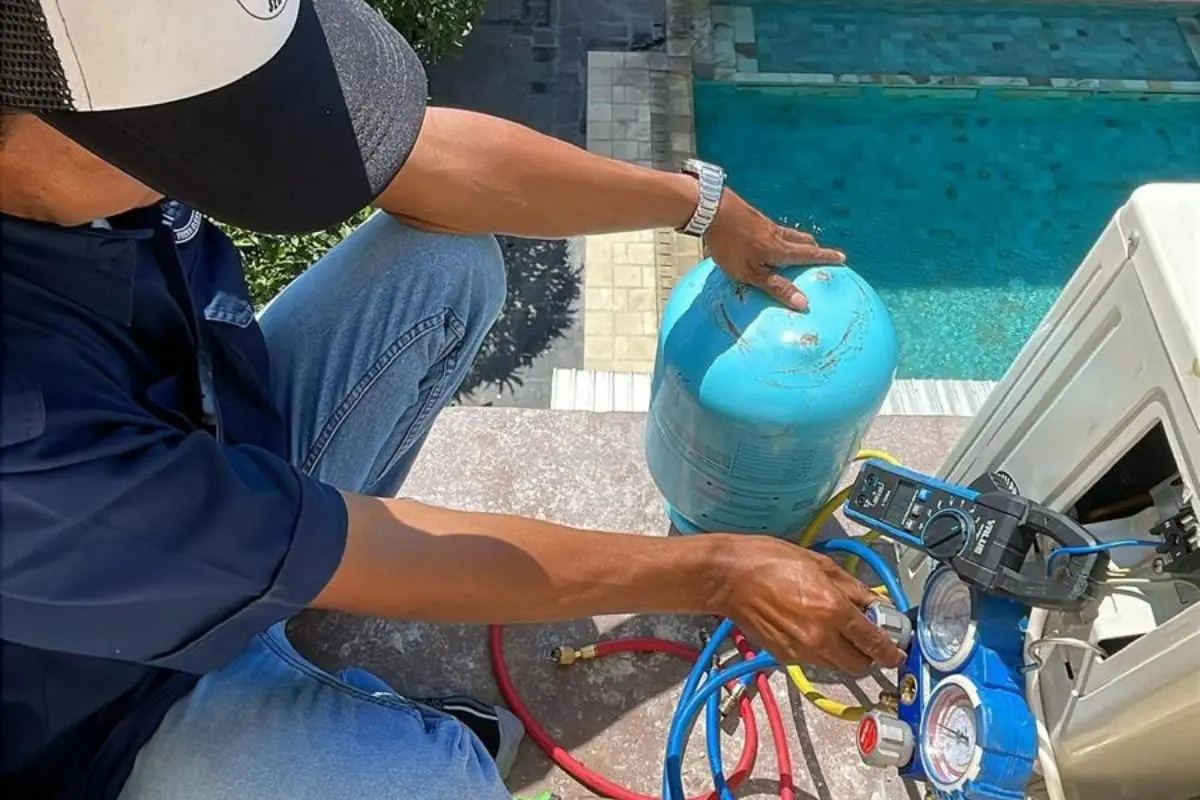
Bali Runs Air Conditioners Harder Than Anywhere Else
Heat, humidity, dust and salt air mean a unit here does in three months what a unit in Europe does in a year. Quarterly servicing is not over-servicing — it is the minimum that keeps a system efficient and a compressor alive.
Plumbing & Water
Blockages, leaks, hot water and water bills
01How does a plumber find and clear a blocked drain?
With the right tools and the right questions. A simple drain snake handles a straightforward clog; more serious problems need CCTV camera inspection, a water jetter or drain rods.
We start by asking where the blockage shows itself and how it behaves, which usually tells us whether we are dealing with a local clog, a fat and debris build-up, or root infiltration in the run outside. Our vans carry the equipment to diagnose it and clear it properly, not just push it further down the line.
02What are the benefits of a solar hot water system?
Bali gets the sunshine to make solar hot water genuinely worthwhile. These systems cut electricity consumption, lower your PLN bill and reduce emissions, and they are far tidier on a roof than a large traditional tank.
The installation cost looks high on day one, but on a villa with steady hot-water demand the system typically pays for itself over its working life.
03Why is my water bill suddenly so high?
A sudden jump almost always means something underneath has changed. The usual causes are:
- Leaking toilets, taps, irrigation lines or underground pipes
- Old or inefficient fixtures
- A change in use — more guests, more laundry, topping up the pool
- Habits: long showers, taps left running, overwatering the garden
- A burst or hidden pipe
To test for a leak, turn off every tap and appliance, then check the meter. If it is still turning, or if your bore pump keeps cycling with nothing running, call us — that is water disappearing into the ground and, often, into a wall.
04Is a dripping tap really a big deal?
Yes. It wastes a surprising volume of water over a month, and more importantly it tells you something in the system has failed: a worn O-ring, a corroded valve, a spent washer, or pressure problems further back.
It is a cheap fix now and an expensive one later.
05Why do my drains smell, and how do I fix it?
Drains are designed to keep smells out. Every one has a U-shaped trap holding a small amount of water, and that water is the seal that stops sewer gas rising into the room.
In Bali the usual culprit is evaporation: a guest bathroom or spare shower goes unused for a few weeks in the heat, the trap dries out, and the seal is gone. Pour a jug of water down any drain you rarely use and the smell normally disappears within minutes.
If it persists, the problem is deeper — a venting fault, a damaged trap or a partial blockage — and needs inspection.
06How do I know when to replace my hot water system?
Repeated repairs are the clearest signal. Alongside that, watch for:
- Water that no longer gets as hot as it used to
- Slow recovery between showers
- Age — units past 10 years are usually well down on efficiency, and it shows on your electricity bill
- Rust in the water or corrosion visible at the fittings
Replacing an old unit with a modern, efficient model often pays back a meaningful part of the cost in running savings.
07My pipes bang when I turn the tap off. What does that mean?
That is water hammer: the shock wave created when fast-moving water is stopped abruptly. Several things can cause it, and identifying the right one matters, because most do-it-yourself remedies either do nothing or make it worse.
Left alone, water hammer stresses joints and fixings, and can eventually split a pipe — which in a villa means flooding, damaged finishes and a very large water bill. A qualified plumber can diagnose it quickly and fix the actual cause.
Small Leaks, Large Bills
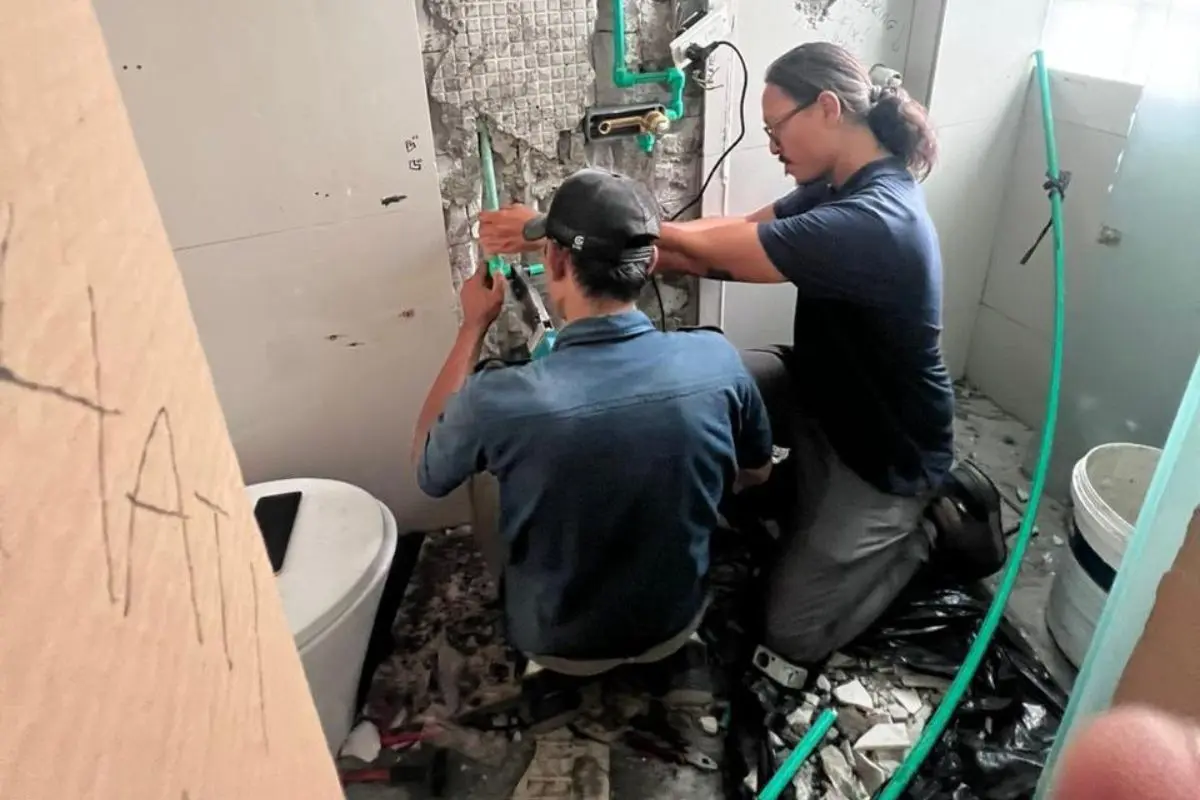
Most of the plumbing emergencies we attend in Bali were not emergencies a month earlier. A dripping tap, a slow drain, a pump that cycles when nobody is home — each one is a warning that costs very little to act on.
Left running, the same faults turn into saturated walls, ruined finishes, mould behind the paint and a water bill nobody can explain. This is exactly what a scheduled maintenance visit is for.
The cheapest plumbing job is the one booked before the ceiling stains.
Electrical
Inspections, safety, faults and preventive maintenance
01What is electrical maintenance?
Electrical maintenance is the regular inspection, testing, repair and servicing of electrical systems, equipment, wiring, panels and devices, to make sure they operate safely, reliably and efficiently.
It covers everything from the incoming supply and distribution panel through to the sockets, switches and fixed equipment around the property.
02Why is electrical maintenance important?
It prevents electrical hazards, equipment failure, power outages, fire risk, electric shock and expensive emergency repairs, and it extends the working life of your equipment.
In Bali there is an additional reason. Humidity and salt air corrode terminals and connections, and corroded connections generate heat. Heat is what turns a loose screw in a panel into a fire.
03How often should electrical systems be inspected?
The schedule depends on the building and how hard the equipment works. Homes may need an inspection every few years, while commercial and industrial facilities usually need more frequent checks — annually, quarterly, or monthly for critical systems.
For Bali villas we suggest shorter intervals than the standard advice, particularly for rental properties, coastal locations and any building with pool pumps, water pumps or heavy air-conditioning loads running daily.
04What are the common signs of an electrical problem?
Watch for:
- Flickering lights
- A burning smell near outlets or panels
- Circuit breakers tripping frequently
- Buzzing from switches or panels
- Warm or discoloured outlets
- Sparks when plugging in equipment
- Sudden loss of power in certain areas
Any of these warrants an inspection. A burning smell warrants one immediately.
05What does preventive electrical maintenance include?
A preventive visit may include:
- Inspecting wiring and connections
- Checking circuit breakers and panels
- Testing grounding systems
- Cleaning electrical equipment
- Tightening loose connections
- Testing emergency lighting
- Checking motors, transformers and generators
- Detecting overheating or abnormal conditions
06Can I do electrical maintenance myself?
Some of it. Inspecting cords for damage, replacing light bulbs and keeping the area around your electrical panel clear are all sensible things to do yourself.
Repairs, fault-finding, rewiring and any work inside the panel should always be handled by a trained and qualified electrical technician. This is the one area of property maintenance where a mistake is not merely expensive.
07Are your technicians qualified?
Yes. Our technicians are qualified and experienced in electrical maintenance work, and hold K3 Indonesia electrical certification. That covers proper safety procedures, electrical standards and workplace safety requirements.
Work that requires a separately licensed specialist or a utility connection is referred on rather than attempted.
08What causes circuit breakers to trip frequently?
Frequent trips usually come down to:
- Overloaded circuits
- Short circuits
- Ground faults
- Faulty appliances or equipment
- Loose wiring
- A damaged breaker
A breaker that trips is doing its job. A breaker that trips repeatedly is telling you something is wrong, and resetting it without finding out what is the wrong response. Have the system inspected.
09How can I reduce electrical hazards?
Practical steps that make a real difference:
- Avoid overloading outlets
- Replace damaged cords rather than taping them
- Keep water away from electrical devices
- Use correctly rated extension cords
- Install proper protection devices
- Keep electrical panels accessible, not boxed in behind furniture
- Schedule regular inspections
10What should I do if I smell burning from an outlet or panel?
Treat it as urgent:
- Turn off power to the affected area if it is safe to do so.
- Do not touch hot outlets, switches or wiring.
- Unplug devices only if it is safe.
- Contact a qualified electrical technician immediately.
- If there is smoke or fire, call emergency services first.
A burning smell means something is already overheating. It does not wait until the morning.
11Why do my lights flicker?
Flickering can come from a loose bulb, a poor connection, voltage fluctuation, an overloaded circuit, a faulty switch, or a problem with the incoming supply.
In Bali, supply-side voltage fluctuation is common enough that people stop noticing it. If the flickering is regular, or affects several areas at once, have the system inspected rather than assuming it is just the grid.
12What is preventive maintenance?
Preventive maintenance is planned work carried out before anything goes wrong. It finds developing faults early and reduces the risk of breakdowns, safety hazards and unexpected downtime.
13What is corrective maintenance?
Corrective maintenance is repair work carried out after a fault or failure has already happened: replacing damaged components, repairing wiring, or restoring power to faulty equipment.
Both have their place. The ratio between them is a good measure of how well a property is being looked after.
14Do you cover commercial and industrial properties?
Yes. Electrical maintenance can be provided for commercial buildings, offices, warehouses, factories, workshops and industrial facilities, depending on the system requirements.
Larger sites are assessed first so the programme matches the actual load and criticality rather than a generic schedule.
15What records should be kept after electrical maintenance?
Keep:
- Inspection reports
- Test results
- Repair history
- Equipment condition reports
- Maintenance schedules
- Technician notes
- Recommendations for future repairs or upgrades
These matter more than people expect. A documented history tells the next technician what has already been ruled out, and it is what an insurer asks for after an incident.
16When should I call an electrical technician?
Call if you notice frequent breaker trips, burning smells, sparks, electric shocks, flickering lights, damaged wiring, overheating equipment or sudden power loss.
If anyone has received a shock, however minor, stop using that circuit and have it checked before it is used again.
17What are the benefits of regular electrical maintenance?
Better safety, less downtime, longer equipment life, lower repair costs, improved energy efficiency and a system you can rely on.
For a rental villa there is a commercial benefit too: a power failure during a guest stay costs a refund, a bad review, or both.
Six Warnings Worth Acting On
Electrical faults announce themselves before they become dangerous. These are the signals our technicians are called to most often, usually later than they should have been.
Still Need An Answer?
If your question is not here, ask us directly. Every message reaches a real person at our office in Bali, and we answer with a straight recommendation rather than a sales pitch.
Fastest route for quotes, photos of a problem and urgent requests. Send a picture and we can usually tell you what you are looking at.
📄 Request a quotation
Tell us the property, the rooms and the service you need. We come back with a written scope and a fixed cost before anything is booked.
🏠 Site assessment
For larger properties, ongoing maintenance or anything structural, we visit, assess and put the recommendation in writing.
🔁 Existing subscribers
Use your usual channel with our office. Subscription clients are prioritised in the schedule and their requests are logged against the property.
Bali Pro Services
One Team For The Whole Property
Air conditioning, plumbing, electrical and general repairs on a fixed monthly plan — scheduled, reported and handled without you chasing anyone.