
4-Step Deep-Cleaning
for Upholstery
Vacuuming only reaches the surface. Our four-step extraction process resets the hygiene baseline of sofas, chairs and seating across Bali — chemistry, agitation, hot-water extraction and steam.

Why Upholstery Needs Professional Deep Cleaning in Bali
Upholstered furniture absorbs everything — body oils, food spills, pet dander, dust, and in Bali's tropical climate the persistent moisture that accelerates mould growth and dust-mite proliferation. Regular vacuuming removes surface debris, but it cannot reach the soils embedded deep in the fibres, nor does it sanitise.
The Indonesia Air Quality Index (AQI) identifies biological contaminants — including dust-mite allergens and airborne mould spores — as a primary indoor air quality concern for residential, villa and commercial spaces.
Surface cleaning treats the symptom. Professional extraction is the only method that genuinely resets the hygiene baseline of upholstered furniture.
The Numbers That Matter
A controlled four-step process gives every stain its best chance of removal — and the tropics make the case for it stronger than almost anywhere else.
Fabrics and Upholstery Types We Clean
We work across all common residential, villa and commercial upholstery found in Bali homes and offices. Each material needs a different approach to chemistry and technique, which is why every job begins with fabric identification before any product is applied.
| Type | How We Treat It |
|---|---|
| 🛋️ Fabric Sofas & Armchairs | The most common residential request — cotton, polyester, linen blends and synthetic microfibre, each matched to the right chemistry. |
| ✨ Velvet & Delicate Weaves | Gentler agitation tools and lower extraction pressure to avoid pile crushing or fibre distortion. |
| 🧶 Microfibre | Highly effective at trapping soils — satisfying to clean, but requires correct chemistry to avoid water marking. |
| 💼 Office & Commercial Seating | High-contact surfaces with accumulated body oils and soiling that standard office cleaning does not address. |
| 🛏️ Cushion Covers & Removables | Treated in situ or separately depending on construction and care-label requirements. |
Note: leather upholstery follows a separate cleaning and conditioning process. Contact us for details on leather sofa care.
Our Four-Step Deep-Clean Process
Every upholstery job follows the same four-step sequence. The steps are not optional or interchangeable — each one prepares the fabric for the next, and skipping any of them reduces the result.
Step 1 — Pre-Spray: Targeted Chemistry
We begin with pre-spray selection — not a generic all-purpose cleaner, but a product matched to the stain type and fabric. The soiling category is identified first:
The solution is applied evenly and left to dwell for a controlled period — long enough for the chemistry to work, not so long that it risks dye migration or backing damage. For unknown stains or delicate fabrics, we start with the mildest effective agent and progress to stronger spotters only after testing an inconspicuous area. All products are EcoLab-approved formulations meeting strict safety and environmental standards.
Step 2 — Agitation: Mechanical Lift
Pre-spray alone does not move soils out of the fabric — it loosens them. Agitation works the solution into the fibres and physically lifts embedded dirt toward the surface where it can be extracted.
Dense Weaves & Synthetics
Worked with rotary brushes that deliver consistent, even mechanical action across the whole surface.
Delicate & Loose Weaves
Velvet, chenille and finer linens are agitated by hand with soft tools and controlled pressure to avoid abrasion or pile distortion.
The Goal
Maximum soil lift with zero mechanical damage to the fabric structure — the tool is always matched to the material.
Step 3 — Hot-Water Extraction: Deep Flushing
Hot-water extraction is the core of the deep clean. Professional equipment injects a controlled-temperature solution under pressure and simultaneously recovers it — along with dissolved soils, pre-spray residue and allergens — through a powerful vacuum.
- Temperature — optimised for soil dissolution without dye or backing risk.
- Pressure — enough to penetrate the fabric without forcing water into the furniture's internal structure.
- Suction — maximised to recover as much moisture as possible and minimise drying time.
On heavily stained areas the pass is repeated until no further soil transfers to the wand — a clear, visual confirmation of what is being removed. The IICRC sets the global standard for hot-water extraction methodology, which informs our technique alongside Indonesia's national professional cleaning competencies.
Book a Sofa Deep Clean in Bali
Four-Step Professional Process · All Fabric Types
EcoLab-approved solutions, available Monday to Sunday, 8am–8pm across Bali.
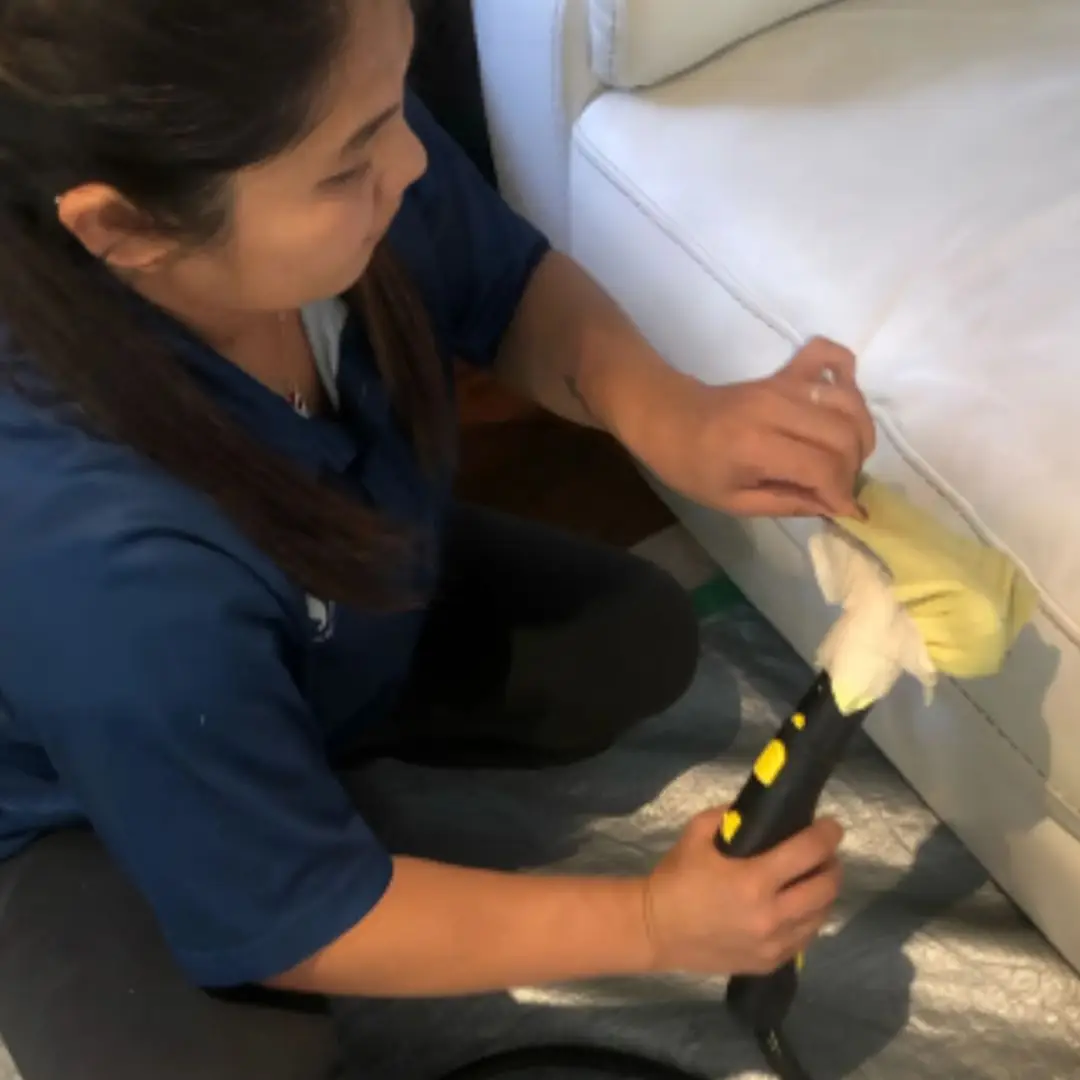
Step 4 — High-Pressure Steam: Targeted Sanitisation
For stubborn stains that remain after extraction, or where deeper sanitisation is required — post-illness cleans, heavy pet soiling, high-contact commercial seating — we apply targeted high-pressure steam. At the correct temperature and pressure, steam disrupts deeply set contaminants and supports further stain breakdown through heat.
Steam is applied selectively, not universally. Before use we test for fabric compatibility — certain dyes are heat-sensitive and some backing materials shrink or distort under steam. Where steam is not appropriate, we achieve sanitisation through extended dwell time with our antimicrobial pre-spray formulations instead.
Drying and What to Expect After the Service
This is a full deep clean involving liquid chemistry and hot-water extraction — fabrics will be damp after service, not dry. That is expected and normal: it is the result of thorough extraction, not over-wetting. Drying time in Bali's climate needs active management, depending on whether your space is enclosed and air-conditioned or an open-air pavilion.
Under these conditions most pieces dry within two to three hours; thicker cushions or heavily padded seats may take a little longer. Our technicians fluff all cushions and open removable covers to maximise airflow before leaving.
Performance and Honest Expectations
Our four-step process gives every stain its best possible chance. In the large majority of cases — around 99 percent — we achieve complete or near-complete removal and a clear improvement in appearance and hygiene. Some stains, however, cannot be fully removed regardless of technique:
| Stain Type | Why It May Not Fully Lift |
|---|---|
| 🧪 Chemically Altered Dyes | Bleach, certain hair products and some cleaning products cause irreversible dye loss that cannot be restored. |
| 🛢️ Deep Oil Saturation | Long-set cooking oil or grease fully bonded with synthetic fibres over months or years. |
| 🖊️ Permanent Marker & Ink | Solvent-resistant pigments that penetrate the fibre at a level extraction cannot reach. |
| 🍷 Long-Set Tannin Stains | Red wine, tea or coffee left to oxidise into the fabric over time without treatment. |
When full removal is unlikely, we tell you before the job proceeds — not after. Transparency here is more important than a sale.
Book Your Upholstery Deep Clean
Our sofa and upholstery cleaning service covers all residential, villa and commercial upholstery types across Bali. Whether you need a single sofa cleaned before guests arrive or a full office seating programme on a recurring schedule, our four-step process delivers results surface cleaning cannot match.
Tell us the fabric, the issue and your location, and we'll confirm the right approach before we start. Contact us to arrange an appointment.
Bali Pro Services
Deep Clean Your Sofa. Four Steps. Proven Results.
Professional extraction · EcoLab-approved solutions · all fabric types. Available Monday to Sunday, 8am–8pm across Bali.