
Waterproofing &
Structural Damp Remediation
Rising damp and foundation settlement are the two most destructive — and most misunderstood — threats to Bali property. Here is how we diagnose and permanently solve them.
Structural Moisture Is an Engineering Problem
Bali's steep volcanic valleys, coastal plains, high groundwater, and intense monsoons expose buildings to some of the most aggressive structural conditions in the world. Left unchecked, moisture climbs into masonry, destroys plaster and finishes, breeds hazardous mould, and ultimately compromises structural safety.
At Bali Pro Services we treat rising damp and foundation failure not as surface defects but as engineering challenges — requiring precise diagnostics and permanent, scientifically proven remediation rather than cosmetic cover-ups.
There are no shortcut sprays or cheap chemical coats that permanently counter the hydrostatic pressures of Bali's tropical climate.
Why Bali Properties Are Highly Vulnerable
The BMKG records prolonged monsoon periods that saturate the upper soil strata rapidly. That reality interacts with three core factors:
How Common Bali Materials Behave
| Material | Porosity & Rising-Damp Risk |
|---|---|
| 🧱 Batako (Concrete Block) | Extremely high porosity — Critical. Acts as a structural wick, drawing groundwater straight up into the wall. |
| 🟥 Bata Merah (Red Clay Brick) | High to medium porosity — High. Prone to rapid capillary draw across the mortar bed and brick face. |
| 🩶 Reinforced Concrete (Sloof / Columns) | Low porosity (dense) — Medium. Resists bulk uptake but tracks moisture along micro-cracks. |
Our Site Inspection & Diagnostic Protocol
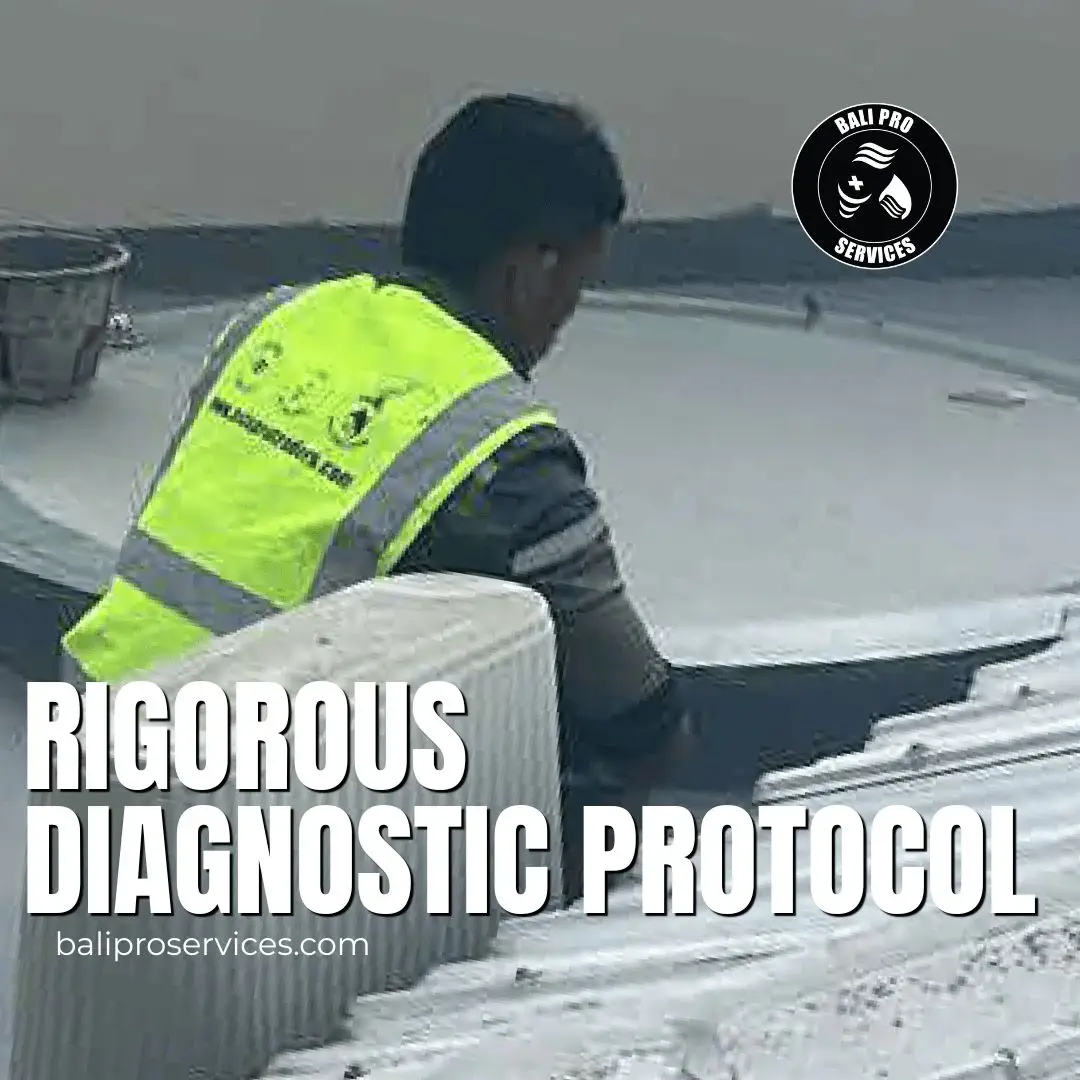
A cure is only as good as its diagnosis. Misreading rising damp for a hidden leak or condensation leads to failed remediation and wasted money. Our protocol has four steps:
Catch It Early
Seeing Tide Marks or Peeling Plaster?
An accurate diagnosis now prevents far costlier structural repairs later. We inspect across all regions of Bali.
Phase 1 — Immediate, Cost-Effective Mitigation
Before any invasive cure, we lower the property's moisture baseline with drainage and environmental controls:
- Site drainage & grading — gutters and downpipes discharged clear of the walls; garden beds regraded to slope water away from the building.
- Correcting ground levels — external paving backfilled above the internal floor level "bridges" the DPC; we lower paths or cut isolation trenches to break soil contact.
- Restoring ventilation — clearing and adding air-vent bricks to increase cross-flow that actively dries saturated masonry.

Phase 2 — Advanced Remedial Solutions
When the cause is entrenched groundwater tracking or active settlement, specialised interventions restore structural integrity.
Chemical DPC Injection
Horizontal holes drilled into the lowest mortar course, then pressure-injected with a silane/siloxane cream. It lines the pores with a hydrophobic silicone resin that reverses capillary draw while still letting the wall breathe.
Physical DPC & External Tanking
For voided or non-uniform stone walls, we excavate to the footings and apply a multi-layer system — polymer-modified cementitious coatings plus elastomeric membranes — sealing the structure from lateral ingress.
Foundation Repair & Underpinning
Where stepped cracking or dropping slabs show active settlement, we work to engineer-designed specs: excavating beneath failing footings to stable strata, pouring reinforced piers, and transferring load onto the new supports.
Protect Your Investment
Protect Your Bali Property Today
Don't let rising damp or structural settlement devalue your home or villa. We offer accurate inspections and long-term engineered remediation across all regions of Bali.
Phase 3 — Drying & Salt Remediation
A barrier stops new water, but thousands of litres can remain trapped above the injection line. Managing the drying phase is vital.
Phase 4 — Breathable Re-Plastering & Finishes
Standard gypsum plaster and high-cement mortar must never go over historically damp walls — they trap residual moisture and fail. We rebuild finishes to breathe.
Salt-Resistant Breathable Render
Polymer-modified or lime-based renders with an open-pore structure let residual sub-surface moisture pass out as vapour, without disrupting the plaster bond or cracking the surface.
Mineral & Silicate Paints
Acrylic and oil paints form a synthetic skin that bubbles and peels within months. Mineral/silicate coatings fuse with the plaster, hold colour, and let moisture escape harmlessly outward.
Long-Term Engineering: Subsurface Drainage
For hillside, rice-field-boundary or high-water-table sites, wall treatments are backed by perimeter drainage that intercepts water before it reaches the building:
- French drains — geotextile-lined trenches of graded gravel around a perforated PVC/HDPE pipe, diverting lateral groundwater to storm channels or soakaways.
- Plinth membranes — cementitious or liquid elastomeric coatings at the foundation-to-wall transition, shedding monsoon downpours and splash-back from the lower perimeter.

Honest Expectations & Integrity
Addressed early — correct diagnostics, proper grading, robust chemical DPC injection and breathable plaster — rising damp is permanently resolved. But where a slab has dropped from deeper soil movement, localised surface fixes are counterproductive: underpinning or structural tie-beams become non-negotiable.
Our philosophy is complete clarity. We deliver comprehensive diagnostic data, state the operational realities plainly, and design remediation engineered to protect your asset for the long term — whether it's early paint peeling in Canggu, chronic salt damage in an Ubud estate, or suspected foundation movement on a new build.
When structural issues are caught early and treated correctly, the resolution is total and permanent.
Bali Pro Services
Protect Your Bali Property Investment Today
Accurate inspections and long-term engineered remediation for rising damp and structural settlement, across every region of Bali.